
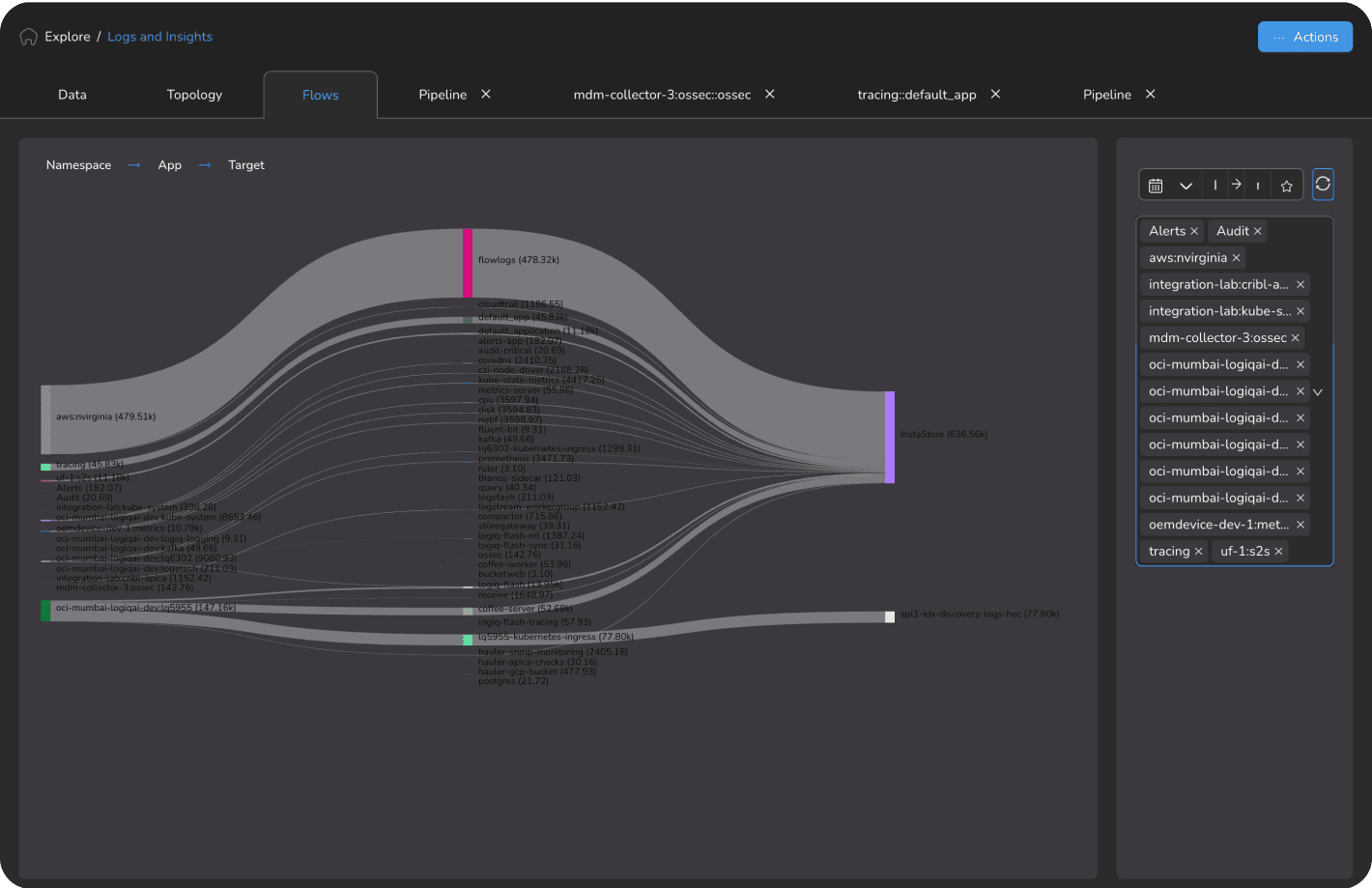
LLM Observability for AI Agents in Production
What is LLM observability?
LLM observability is monitoring for applications built on large language models. It traces every prompt, model call, tool call and response, then ties each one to latency, errors, token cost and output quality. So when an AI agent gives a wrong answer or burns through budget, you can see which step caused it.
AI Applications Demand New Observability Approaches
As organizations rapidly adopt generative AI and large language models, they’re discovering that traditional observability tools weren’t built for AI workloads. LLM applications introduce unique challenges: non-deterministic outputs, token-based costs that can spiral unpredictably, complex multi-step agentic workflows, and latency requirements that directly impact user experience.
And as those LLM applications mature into fully autonomous agentic systems, the challenge compounds further. AI agents don’t just generate outputs — they generate continuous streams of telemetry, tool call records, reasoning traces, and decision logs that existing observability pipelines weren’t architected to handle. The organizations that build the right telemetry infrastructure now will be the ones that can operate agentic AI reliably and affordably at scale.
-
Unpredictable costs
Token usage and API calls create variable costs that are difficult to forecast and control.
-
Performance blind spots
Traditional APM doesn't capture prompt quality, model accuracy, or inference latency specific to LLMs.
-
Compliance risks
Difficulty monitoring for bias, inappropriate outputs, or data privacy violations in AI responses.
-
Debugging complexity
Non-deterministic outputs make it challenging to reproduce issues and understand failure modes.
-
Agentic workflow visibility
Multi-step AI agent chains require end-to-end tracing across model calls, tool usage, and retrieval systems.
-
Telemetry pipeline gaps
AI agents generate 10–100x more telemetry than traditional applications — most organizations have no cost-efficient way to route, govern, and store it without breaking their observability budget.
Comprehensive LLM and AI Application Monitoring — With Pipeline-First Telemetry Governance
Apica delivers purpose-built observability for AI and LLM workloads, providing complete visibility into model performance, costs, quality, and compliance — and goes further with a pipeline-first layer that governs the telemetry AI agents generate, routing, filtering, enriching, and storing it cost-efficiently before it reaches expensive indexing platforms.
- Unpredictable costs: No visibility into token usage until bills arrive; no per-feature or per-model attribution
- Performance blind spots: Traditional APM can't capture prompt quality, inference latency, or model accuracy
- Compliance gaps: No monitoring for bias, inappropriate outputs, or PII in AI responses
- Debugging complexity: Non-deterministic outputs make issue reproduction nearly impossible
- Agentic workflow opacity: Multi-step AI chains have no end-to-end tracing or visibility
- Telemetry cost explosion: AI agent workloads generate 10–100x more telemetry with no cost-efficient pipeline to handle it — every trace, reasoning log, and tool call hits expensive ingestion at full price
- LLM-specific metrics: Track token usage, cost per request, inference latency, and model accuracy in real time
- Agentic workflow tracing: End-to-end visibility across multi-step AI agent chains and tool usage
- Prompt and response monitoring: Capture and analyze prompt quality, response accuracy, and output appropriateness
- Cost attribution: Understand AI spending by model, feature, customer, or user cohort
- Compliance monitoring: Continuous validation of AI outputs against policies and regulatory requirements
- Pipeline-first AI telemetry governance: Filter, enrich, and route AI agent telemetry before costly platform ingestion — controlling the cost of observing AI, not just the cost of running it
The Apica advantage: We give AI engineering teams the insights they need to optimize performance, control costs, and maintain compliance — without waiting for monthly billing surprises or building a second telemetry infrastructure for AI workloads.
Complete Visibility Into AI Workloads
Apica captures the metrics, traces, and behavioral signals that matter for AI applications — from individual LLM calls through multi-step agentic workflows — while governing the telemetry pipeline that carries all of it.
LLM Performance Monitoring
- Track inference latency, throughput, and error rates per model and deployment
- Monitor token usage patterns and identify optimization opportunities
- Detect performance regressions when model versions change
- Baseline normal behavior and alert on deviations
Token Cost Attribution
- Real-time cost tracking by model, feature, team, and customer cohort
- Budget alerting before spend spirals out of control
- Identify high-cost prompts and optimize for efficiency
- ROI reporting for individual AI features and use cases
Agentic Workflow Tracing
- End-to-end tracing across multi-step AI agent chains
- Visibility into tool calls, retrieval operations, and model interactions
- Identify bottlenecks and failures in complex agentic pipelines
- Full context for debugging non-deterministic outputs
Compliance & Quality Monitoring
- Continuous monitoring of AI outputs for policy violations and inappropriate content
- PII detection in prompts and responses before they reach storage
- Prompt quality scoring and response accuracy tracking
- Audit trails for regulatory compliance across all AI interactions
AI Telemetry Pipeline Governance (Powered by Apica Flow)
As AI agents scale from POC to production, the telemetry they generate becomes as much a cost problem as a visibility problem. Apica Flow brings pipeline-first control to AI workloads:
- Filter routine LLM output logs and tool call noise before they hit expensive indexing tiers
- Route AI agent traces, reasoning logs, and decision records to cost-optimized storage with full replay capability
- Apply dynamic sampling policies that preserve agent decision traces and anomaly signals while filtering high-volume routine outputs
- Store AI agent interaction histories and LLM telemetry at object storage economics via InstaStore™ — with instant queryability when you need to audit, retrain, or replay
- Enrich AI telemetry with business context (customer tier, session ID, feature flag) before routing to downstream analytics
AI Validation via Synthetic Monitoring (Apica Vanguard)
Synthetic checks provide the known-result validation signals that agentic systems depend on to confirm they're operating correctly:
- Simulate real user and AI agent workflows globally to catch degradation before it reaches production
- Use synthetic probe results as ground-truth signals to detect AI hallucination and verify autonomous decision outputs
- Expose synthetic check data as a native stream in Apica Flow — apply full pipeline governance including filtering, enrichment, and cost routing
- Validate agentic journey completion rates end-to-end, not just individual model call success
See it live on your AI infrastructure — models, agents, and all.
AI Applications You Can Trust and Afford
Results based on Apica customer deployments. Individual results may vary based on environment complexity and implementation scope.
Enterprise SaaS: AI Feature Team
$45K/month in LLM API costs with no visibility into which features or customers drove spend. Costs growing 40% month-over-month.
Apica LLM observability for token cost attribution, prompt quality monitoring, and agentic workflow tracing.
- 62% reduction in LLM API costs through prompt optimization and model routing
- Per-feature cost attribution enabled ROI analysis for every AI capability
- Compliance monitoring identified prompt injection attempts in first week
- Inference latency improved 38% after identifying inefficient retrieval patterns
Results based on Apica customer deployments. Individual results may vary based on environment complexity and implementation scope.
Financial Services: AI Risk Platform
Regulatory requirement to prove AI outputs meet compliance standards with no tooling to monitor LLM responses for policy violations.
Apica compliance monitoring with full audit trails for all AI interactions and automated policy violation detection.
- 100% compliance audit coverage across all AI-generated outputs and decisions
- Policy violation detection reduced manual review burden by 78%
- Met regulatory audit requirements with complete AI decision trails
- PII in prompts detected and redacted before storage in 100% of cases
Built for the AI Observability Gap — And the Telemetry Pipeline Behind It
Traditional observability platforms weren't designed for generative AI. Apica provides the LLM-native telemetry and analysis capabilities that AI engineering teams need — plus the pipeline-first architecture that governs the telemetry AI agents generate at scale. That combination is what separates Apica from point-solution LLM monitoring tools that observe AI but can't control the cost of doing so.
LLM-Native Observability
Captures the metrics that matter for AI — token usage, prompt quality, inference latency, model accuracy — not just generic APM metrics that miss what's unique about LLM workloads.
Real-Time Cost Control
Per-request cost attribution across models, features, customers, and teams. Budget alerting before spend spirals. No more monthly billing surprises from runaway AI usage.
Agentic-Ready Tracing
End-to-end tracing across multi-step AI agent chains. Full visibility into tool calls, retrieval operations, and model interactions — the complexity that matters as AI workflows grow.
Compliance by Design
Continuous monitoring for policy violations, PII in prompts, bias in outputs, and inappropriate responses. Complete audit trails for regulatory compliance. AI you can prove is safe.
Pipeline-First AI Telemetry
The only AI observability platform with a pipeline-first architecture purpose-built for AI-era data volumes. Filter, route, and store AI agent telemetry cost-efficiently — handling 10–100x volume growth without a proportional spike in observability spend. InstaStore™ provides infinite, instantly queryable retention for prompt histories, agent decision logs, and compliance records. Observe your AI and govern it, in one platform.
Synthetic AI Validation
Vanguard's synthetic monitoring extends into the AI stack, simulating real user and AI agent workflows to validate that autonomous systems are performing within expected parameters. Known-result synthetic signals detect hallucination and verify agentic decision outputs — before they reach your users. New in Ascent 2.16: synthetic check data is now a native stream in Apica Flow, enabling full pipeline governance of your AI validation signals.
LLM observability vs AI agent observability
LLM observability tracks individual model calls: the prompt, the response, the tokens, the latency and whether the output was any good. AI agent observability zooms out to the whole run. An agent plans, calls tools, queries a vector store, hands work to sub-agents and retries, so one request can involve dozens of steps. You need both views. The model call tells you what went wrong in one answer, and the agent trace tells you which step in the chain caused it, and what the whole run cost.
Token cost attribution per agent
Model providers bill by the token, but the provider’s bill doesn’t know which of your agents made each call. To control spend, you need to tie every call’s input and output tokens to the agent, feature and customer that triggered it. In practice that means tagging each model span with the model name, token counts and your own business context, then rolling costs up by those tags. Once you can see that one agent’s retry loop burns more tokens than the rest of the app combined, the fix is usually obvious. Apica does this attribution in real time, by model, feature and user.
OpenTelemetry GenAI semantic conventions
The OpenTelemetry GenAI semantic conventions are the emerging standard names for LLM and agent telemetry. They define gen_ai.* attributes such as gen_ai.request.model, gen_ai.usage.input_tokens and gen_ai.usage.output_tokens, plus span types for model calls, tool execution (execute_tool) and agent runs (invoke_agent). As of mid-2026 they’re still marked Development in the OpenTelemetry registry, so names can change between releases. Instrument to them anyway and pin the version you use. It keeps your traces portable between backends, which matters in a market where vendors keep getting acquired.
LLM observability tools compared
| Tool | Pricing | Deployment | Open source | Best for |
|---|---|---|---|---|
| Apica Ascent | Free plan up to 1 TB/month through the pipeline; usage-based or annual contract beyond that | SaaS or on-premises | No | Controlling the cost of AI telemetry across the whole stack, alongside your existing tools |
| Arize (Phoenix and AX) | Phoenix free to self-host; AX Free 25K spans/month; AX Pro $50/month for 50K spans | Self-hosted (Phoenix) or SaaS (AX) | Phoenix is source-available (Elastic License 2.0) | Evaluation-heavy teams and ML teams already on Arize |
| Langfuse | Free up to 50K units/month; Core $29/month for 100K units, then $8 per 100K | Cloud or self-hosted | Yes (MIT core) | Self-hosted tracing, prompt management and evals |
| Datadog LLM Observability | Free up to 40K LLM spans/month; Pro from $160/month for 100K LLM spans | SaaS | No | Teams already running Datadog APM |
List prices as of September 2026, from vendor pricing pages where published.
Go Deeper
Related blog posts, product pages, and documentation for AI engineering teams.

Apica Telemetry Pipeline at AWS re:Invent 2025: Powering AI, Security, and Cost Optimization in the Cloud
Read article →
OpenTelemetry: The Foundation of Modern Observability Strategy
Read article →
OpenTelemetry Best Practices
Read the docs →
Common Use Cases for OpenTelemetry
Read the docs →
Apica Vanguard
Synthetic monitoring that simulates real user and AI agent workflows globally.
Explore the product →
Apica Wayfinder
On-demand, compliant test data for agentic journeys.
Explore the product →