
Migrate from Legacy Tools with Zero Downtime
Cloud Migration Creates Observability Gaps
Organizations modernizing their infrastructure face a critical challenge: maintaining visibility during the transition. Migrating from legacy tools like Splunk or on-premises monitoring platforms to cloud-native observability creates risks — data loss during cutover, performance degradation due to unfamiliar tooling, compliance violations from data residency changes, and business disruption if monitoring fails during migration.
In 2025 and 2026, a new forcing function is accelerating cloud migration: AI readiness. Traditional on-premises infrastructure cannot support AI workloads that require elastic GPU access, petabyte-scale data processing, and the real-time telemetry pipelines that agentic systems demand. Organizations are migrating to cloud not just to modernize but to enable the AI agents that represent their next competitive frontier. That makes the observability layer you land in more consequential than ever. A migration that delivers cloud infrastructure without agentic-ready telemetry management is a migration that sets up the next disruption.
-
Business continuity risk
Switching observability platforms creates potential for monitoring gaps during critical transition periods.
-
Vendor lock-in
Legacy platforms like Splunk make migration expensive and complex through proprietary data formats.
-
Cost explosion
Lift and shift approaches to cloud often result in 2–3x increase in observability costs.
-
Tool sprawl
Organizations add cloud-native tools without removing legacy systems, creating operational overhead.
-
Hybrid complexity
Maintaining visibility across on-premises and cloud during multi-year migrations.
-
AI readiness gap
Migrating to cloud to enable AI workloads, then landing in an observability architecture not built for 10–100x agentic telemetry volumes, leaving teams to face the same architectural disruption again within 18 months.
Risk-Free Migration with Parallel Operations — Landing in an Agentic-Ready Architecture
Apica enables zero-downtime migration from legacy observability platforms to modern, cost-efficient telemetry management. Our approach doesn't force rip-and-replace. Instead, we run parallel with existing tools during migration, providing safety net visibility while you transition at your own pace. And when migration is complete, you land in a pipeline-first, agentic-ready architecture built to handle the AI workloads that are driving cloud modernization across the enterprise.
- Big-bang cutover risk: Switching platforms creates monitoring gaps that expose critical systems
- Vendor lock-in: Splunk and legacy proprietary formats make data portability expensive
- Cost explosion: Lift-and-shift approaches carry legacy inefficiencies into cloud environments
- Hybrid blind spots: Separate tools for on-premises and cloud create fragmented visibility
- Skills gap: Teams trained on legacy tools struggle during platform transitions
- AI readiness debt: Migrating to a modern observability platform that still isn't built for agentic AI telemetry volumes, setting up the next costly migration before the current one is finished
- Parallel operation: Dual-ship telemetry to legacy and new platforms simultaneously during transition
- Incremental migration: Move workload by workload, team by team, at your own pace
- Zero data loss: Never Block, Never Drop guarantee ensures complete visibility throughout migration
- Cost optimization: Reduce overall observability spend 40% even while running parallel systems
- Hybrid visibility: Unified platform for on-premises and cloud infrastructure during transition
- Agentic-ready landing: Migrate into a pipeline-first architecture built for AI-era data volumes so the observability foundation you build today supports the AI workloads arriving tomorrow
The Apica advantage: We make migration safe, gradual, and economically beneficial, not a high-risk, big-bang event. And we make the destination worth arriving at.
Parallel Migration Without Risk
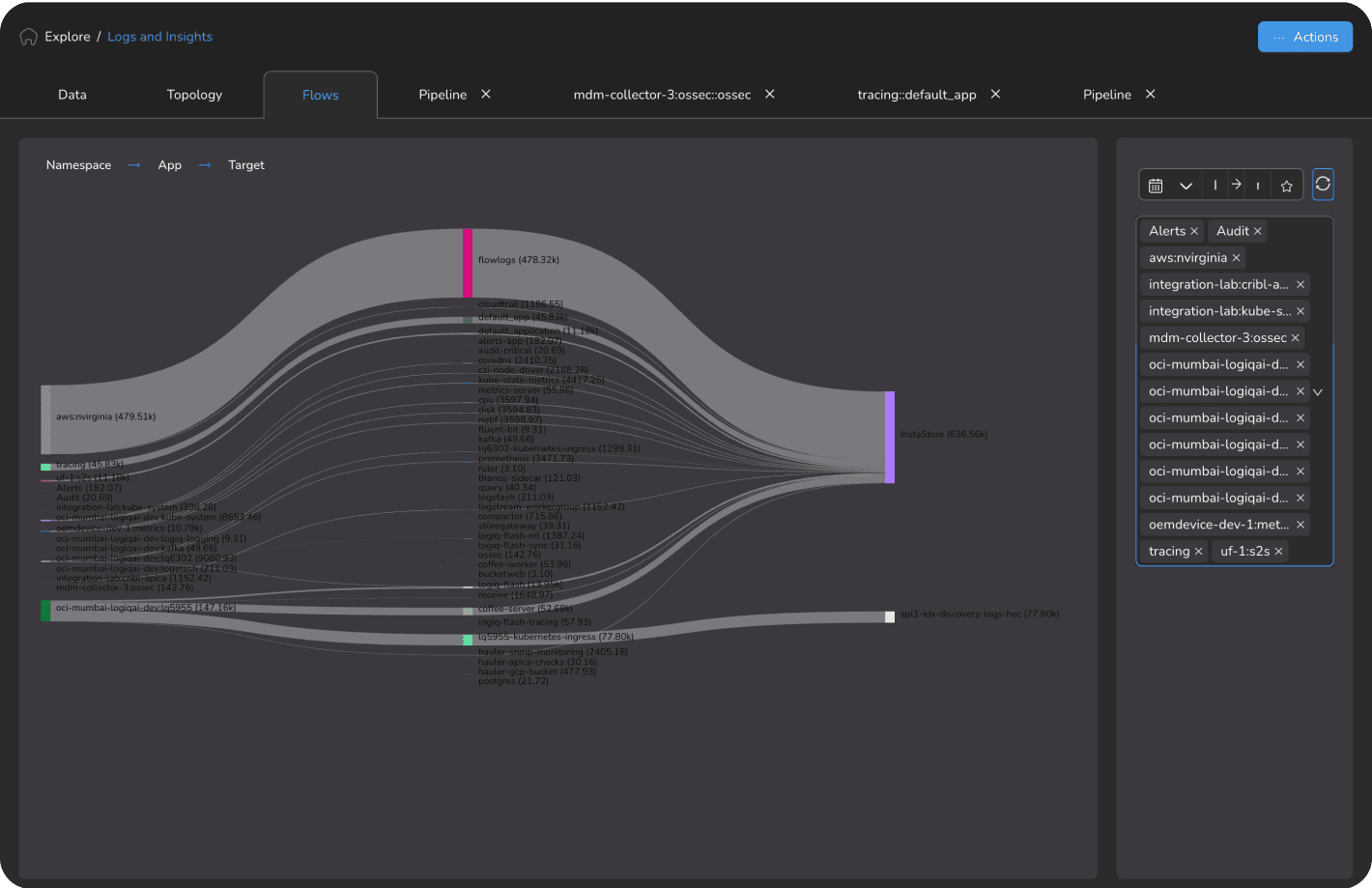
Apica's dual-ship architecture lets you run legacy and modern observability in parallel, validating data parity before cutting over, with zero business disruption at every stage. And the architecture you migrate into is purpose-built for what comes next: Agentic AI workloads that demand elastic, pipeline-first telemetry management.
Dual-Ship Telemetry
- Route the same telemetry to both legacy (Splunk, legacy TSDB) and Apica simultaneously
- Validate data parity between old and new platforms before cutting over
- Zero data loss during the entire migration period
- Switch traffic gradually — 10%, 25%, 50%, 100% — with rollback at any point
Cost Optimization During Migration
- Reduce observability spend 40% even while running both systems in parallel
- Pre-Splunk filtering reduces ingestion volume before migration completes
- Identify and eliminate redundant data streams early in the process
- Business case improves month-over-month throughout the migration
Hybrid Infrastructure Visibility
- Single platform for on-premises and cloud during multi-year migration programs
- Consistent monitoring across legacy data centers and cloud-native workloads
- Migration progress dashboards showing data flow between environments
- Compliance continuity — data residency controls maintained throughout
Zero Data Loss Architecture
- Never Block, Never Drop guarantee — all telemetry captured at every stage
- Data replay capability covers any gaps from configuration changes during migration
- Historical data accessible across both environments during parallel phase
- Post-migration, full history available in Apica without re-ingestion
Agentic-Ready Architecture at Landing
The reason most organizations are accelerating cloud migration in 2025 and 2026 is AI. Traditional infrastructure cannot support AI workloads requiring elastic GPU access, petabyte-scale pipelines, and the 10–100x telemetry volumes that production AI agents generate. Apica ensures the observability architecture you migrate into is built for what's coming:
- Pipeline-first design routes, filters, and governs AI agent telemetry before costly platform ingestion, from day one post-migration
- Elastic, Kubernetes-native architecture scales instantly to accommodate AI-scale data volumes without reconfiguration
- OpenTelemetry-native collection future-proofs instrumentation. Instrument once, route anywhere, eliminate the next migration pain
- InstaStore™ provides infinite, instantly queryable retention for AI agent interaction histories, decision logs, and compliance records at object storage economics
- Never Block, Never Drop guarantee extends to AI workloads. No telemetry dropped regardless of volume spikes from agentic systems
Migration That Pays for Itself
Results based on Apica customer deployments. Individual results may vary based on environment complexity and implementation scope.
Enterprise SaaS: Platform Migration
$8M annual Splunk spend. Migration needed without monitoring gaps during transition. 18-month program with 300+ services to move.
Apica parallel operation with dual-ship pipeline — telemetry routed to both Splunk and Apica simultaneously. Gradual 25/50/75/100% traffic shift over 8 months.
- 47% cost reduction achieved by month 4 — still running both platforms
- Zero monitoring gaps during entire 8-month migration
- Data parity validated at each traffic milestone before progressing
- Complete Splunk migration completed — $3.8M annual savings locked in
Results based on Apica customer deployments. Individual results may vary based on environment complexity and implementation scope.
Financial Services: Cloud Modernization
12-year-old on-premises monitoring stack. Cloud migration required maintaining hybrid visibility for 2+ years during transition.
Apica hybrid deployment spanning on-premises data centers and AWS, with unified dashboards and alerting across both environments.
- 100% visibility maintained across legacy and cloud environments throughout migration
- Compliance data residency controls preserved during all migration stages
- 52% reduction in monitoring costs within 6 months of parallel operation
- Full cloud migration completed with zero audit findings on observability continuity
Results based on Apica customer deployments. Individual results may vary based on environment complexity and implementation scope.
Emerging Use Case: Migrating to Enable Agentic AI
For a growing share of organizations, cloud migration in 2025 and 2026 is fundamentally about AI readiness: Getting infrastructure and data pipelines into a state where AI agents can be deployed reliably at scale. Industry research confirms that traditional on-premises infrastructure cannot support the elastic GPU access, petabyte-scale data processing, and real-time telemetry pipelines that agentic systems require.
Apica supports this migration pattern directly.
- Migrate your observability infrastructure and your telemetry pipeline simultaneously, landing in an agentic-ready architecture rather than a modern-but-not-AI-ready one
- Ensure the pipeline you build during migration can handle 10–100x telemetry growth from production AI agents without reconfiguration or additional cost
- Use the migration moment to standardize on OpenTelemetry instrumentation so future model changes, agent deployments, or platform swaps don't trigger another migration cycle
- Land with complete data ownership and open formats. No vendor lock-in that constrains AI data strategy as governance requirements evolve
The organizations that treat cloud migration as an AI readiness initiative, not just a platform modernization, will avoid the architectural debt that's already building up at competitors.
Migration That Protects Your Business — and Prepares It for What's Next
Unlike forced rip-and-replace migrations, Apica's parallel approach protects business continuity, reduces risk, and delivers cost savings during the migration itself. And unlike observability platforms that modernize your tooling without modernizing your architecture, Apica lands you in a pipeline-first, agentic-ready foundation built for the AI era.
Safety Net Architecture
Dual-ship telemetry to both legacy and modern platforms simultaneously. Validate data parity, migrate workloads gradually, and roll back instantly — with full visibility at every stage.
ROI During Migration
40% cost reduction achievable even while running parallel systems. Pre-Splunk filtering and intelligent routing start delivering savings from day one — you don't have to wait for migration to complete.
Never Block, Never Drop
No data loss at any migration stage. Data replay covers configuration gaps. Complete historical context available across both systems throughout the transition period.
Hybrid by Design
Built for the realities of multi-year migration programs. Unified visibility across on-premises and cloud environments. Compliance and data residency controls maintained throughout.
Agentic-Ready at Landing
The destination matters as much as the journey. Apica's pipeline-first architecture means the observability foundation you build during migration is already designed for the AI workloads that are driving cloud modernization across the enterprise. Elastic, Kubernetes-native, Never Block Never Drop and built for 10–100x telemetry growth without reconfiguration. Migrate once. Don't migrate again.
Go Deeper
Related blog posts, product pages, and documentation for cloud migration teams.

Lightstep/Cloud Observability EOL: Keep Your Incident Management Workflows Running with Apica + ServiceNow
Read article →
Banking and Finance
View solution →
Replay
View solution →
Apica Flow
Control and route telemetry before ingestion with zero data loss
Explore Flow →
Cost Savings
Reduce observability spend 40% without sacrificing visibility
Read use case →