
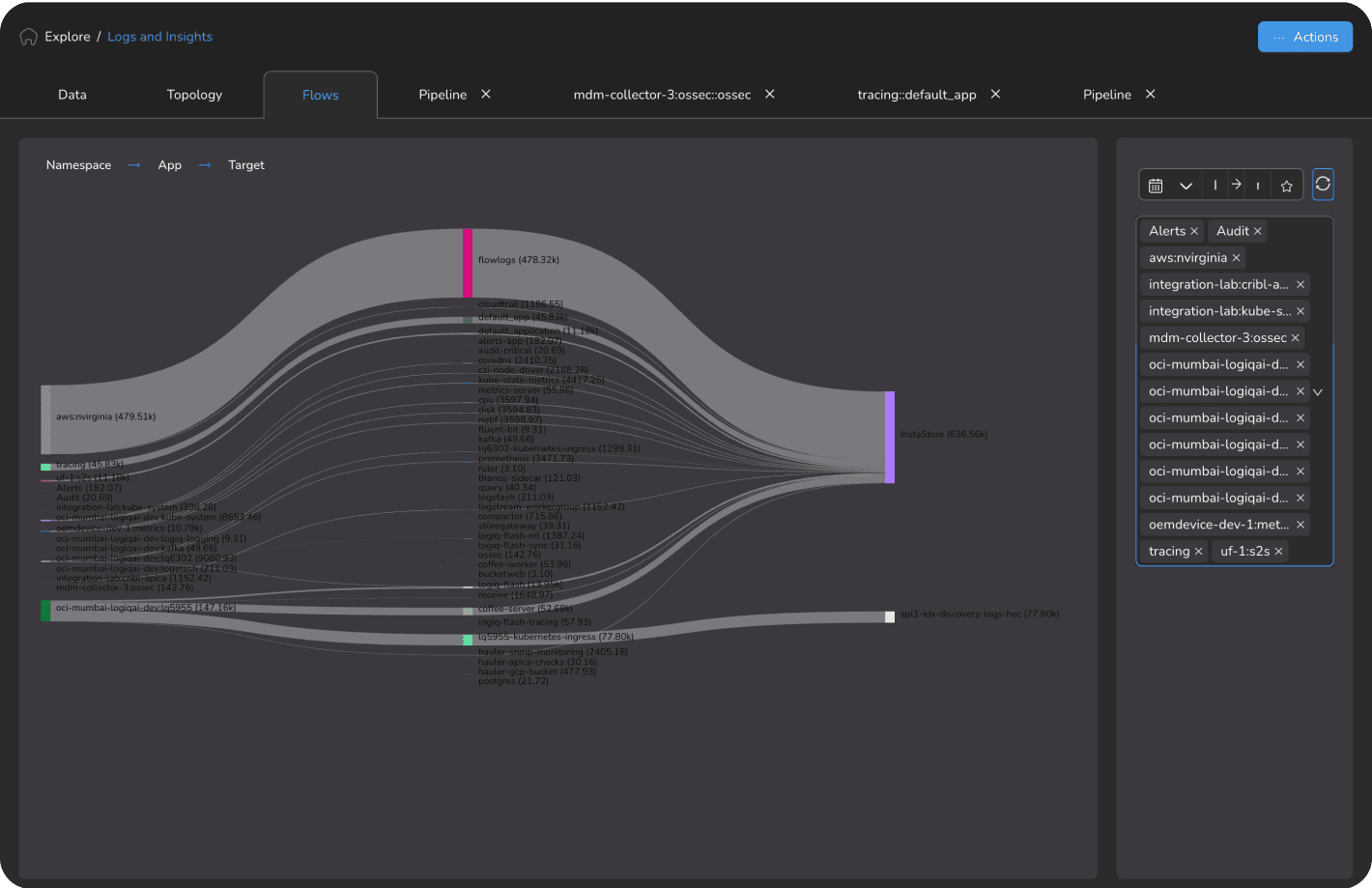
Accelerate Incident Resolution and Improve System Reliability
SRE Teams Drowning in Complexity — And AI Is About to Make It Exponentially Worse
Modern cloud-native architectures generate overwhelming volumes of telemetry data across distributed systems, making it increasingly difficult for SRE teams to maintain reliability at scale. The average organization uses 10+ different observability and monitoring tools, creating fragmented visibility that slows incident response and increases operational toil.
Now add autonomous AI agents to that environment, and the reliability challenge fundamentally changes. AI agents making real-time decisions in production can fail silently, hallucinate, or cascade errors in ways that traditional monitoring was never designed to detect. A single AI agent can generate 10–100x more telemetry than a traditional application and the incidents it causes don’t look like the incidents SRE runbooks were written for.
-
Alert fatigue
SREs receive hundreds of alerts daily across disconnected tools, making it impossible to identify critical issues.
-
Slow mean time to resolution (MTTR)
Fragmented data silos force engineers to context-switch between multiple platforms during incidents.
-
SLO/SLI blind spots
Difficulty tracking service level objectives across distributed microservices and hybrid cloud environments.
-
Manual toil
Repetitive troubleshooting tasks consume time that should be spent on innovation and reliability engineering.
-
High cardinality complexity
Modern Kubernetes environments with ephemeral containers create millions of unique metric combinations that traditional platforms can't handle efficiently.
-
Agentic AI blind spots
AI agents operating in production generate unpredictable telemetry at extreme cardinality, fail in non-deterministic ways, and require new reliability contracts that existing SLO frameworks weren't built to support.
Unified Observability Built for SRE Workflows — Including Agentic AI
Apica delivers complete visibility across your entire infrastructure with AI-powered insights and automation purpose-built for site reliability engineering. Our platform combines telemetry pipeline control, real-time observability, and intelligent analytics to help SRE teams detect issues faster, resolve incidents more efficiently, and proactively maintain system reliability across traditional microservices and the autonomous AI systems that are now entering production environments.
- Alert fatigue: Hundreds of noisy alerts daily across disconnected tools with no correlation or prioritization
- Slow MTTR: Fragmented data silos force context-switching between multiple platforms during live incidents
- SLO blind spots: No unified view of service level objectives across distributed microservices
- Manual toil: Repetitive troubleshooting tasks steal engineering time from reliability work
- High cardinality limits: Traditional platforms can't efficiently handle Kubernetes-scale metric volumes
- Agentic blind spots: No mechanism to observe AI agent decision traces, validate autonomous outputs, or detect silent failures before they become incidents
- Unified visibility: Single platform for metrics, logs, and traces eliminates context switching during incidents
- Intelligent automation: AI-powered anomaly detection and root cause analysis accelerate troubleshooting
- SLO/SLI tracking: Built-in service level objective monitoring across distributed systems
- Flexible alerting: Smart alert management and event correlation reduce noise, surface critical issues
- High cardinality support: Advanced data handling designed for complex cloud-native environments
- Agentic-ready reliability: Synthetic validation of AI agent workflows, pipeline governance for agentic telemetry, and SLO frameworks built to cover autonomous systems in production
The Apica advantage: We give SRE teams the insights they need, when they need them, without drowning in unnecessary data or tool complexity.
From Detection to Resolution, Faster — Across Every Workload Type
Apica delivers complete visibility across your entire infrastructure, from data collection through anomaly detection, alert management, and historical analysis, giving SRE teams everything they need to resolve incidents faster and prevent them from recurring.
Real-Time Monitoring
- Unified view across applications, infrastructure, and user experience
- Complete MELT (Metrics, Events, Logs, Traces) data correlation in one platform
- Automatic discovery and mapping of service dependencies
- Dynamic infrastructure monitoring that adapts to ephemeral Kubernetes workloads
AI-Powered Anomaly Detection
- Intelligent baseline learning identifies deviations from normal behavior automatically
- Contextual alerts that understand system relationships, not just isolated metrics
- Root cause analysis accelerates troubleshooting by pinpointing exact failure points
- Reduce alert fatigue by 70% through smart noise reduction
- Detect AI agent anomalies: Non-deterministic outputs, unexpected tool call patterns, hallucination signals, and latency spikes in LLM inference pipelines
SLO/SLI Management
- Define and track Service Level Objectives across distributed microservices
- Real-time SLO compliance dashboards with error budget tracking
- Proactive alerting when services approach SLO violations
- Historical SLO reporting for capacity planning and reliability trends
- Define and monitor reliability contracts for AI-integrated services, including response quality thresholds, inference latency SLOs, and agentic workflow completion rates
Intelligent Alert Management
- Automatically group related alerts to reduce duplicate notifications
- Correlate events across metrics, logs, and traces for complete incident context
- Enrich alerts with runbook links, team ownership, and remediation steps
- Route critical incidents to on-call engineers through preferred channels
Instant Historical Analysis
- Instantly replay historical data to understand what changed before an incident
- Compare current behavior against past baselines without slow archive retrieval
- 100% data indexed — search and visualize your data instantly, no matter how old
- Infinite retention enables analysis of seasonal patterns and long-term reliability trends
Adaptive Monitoring Collection
- Automatically adapts to infrastructure changes without manual reconfiguration
- Works with existing observability agents — no rip-and-replace required
- Centralized agent management reduces operational overhead across hybrid environments
- Collect only what you need, route it where it matters
Agentic AI Reliability
- Synthetic check data streams in Apica Flow provide known-result validation signals that detect AI hallucination and verify autonomous decision outputs
- Pipeline governance for agentic telemetry: Filter, enrich, and route AI agent traces before costly platform ingestion
- Real User Monitoring (RUM) dashboard with AI-driven analysis captures endpoint-level performance data that agentic systems serving real users depend on
- SLO tracking purpose-built to cover agentic reliability contracts not just traditional uptime metrics
SRE Teams That Prevent Fires, Not Just Fight Them
Results based on Apica customer deployments. Individual results may vary based on environment complexity and implementation scope.
Global E-Commerce Platform
SRE team managing 200+ microservices across 3 cloud providers with average MTTR of 4.5 hours and 500+ daily alerts across 12 tools.
Apica Observe for unified visibility with AI anomaly detection, Flow for intelligent alert routing and enrichment.
- 73% reduction in MTTR (4.5 hours to 72 minutes)
- Alert volume reduced from 500+ to 40 actionable alerts daily
- 99.95% SLO compliance achieved across all critical services
- SRE team freed from 60% of manual toil to focus on reliability engineering
Results based on Apica customer deployments. Individual results may vary based on environment complexity and implementation scope.
Financial Services Technology Provider
Critical trading platform with zero-tolerance for downtime experiencing 8–12 incidents per month with slow detection due to fragmented monitoring across legacy tools.
Apica platform for complete MELT correlation with InstaStore™ for instant historical investigation.
- Incidents reduced from 12 to 2 per month through proactive detection
- Mean detection time cut from 45 minutes to under 3 minutes
- Historical replay enabled root cause identification in 92% of incidents
- Zero SLA breaches in 18 months post-implementation
Results based on Apica customer deployments. Individual results may vary based on environment complexity and implementation scope.
Emerging Use Case: SRE for Agentic AI Systems
As enterprises deploy AI agents in production, SRE teams are confronting a new category of incident: autonomous failures.
Apica's pipeline-first architecture and synthetic validation capabilities give early adopters the tools to:
- Detect AI agent hallucination and unexpected output patterns before they impact end users
- Apply SLO frameworks to agentic reliability, tracking autonomous workflow completion, inference latency, and decision quality
- Use synthetic probe signals as ground-truth validation that AI agents are operating within expected parameters
- Replay AI agent telemetry streams for post-incident root cause analysis of autonomous decisions
The reliability contract for AI agents is different. Apica is built to honor it.
Built for How SRE Teams Actually Work — Today and as AI Enters Production
Unlike bolt-on observability tools, Apica was purpose-built for the realities of modern site reliability engineering, from the data collection layer through anomaly detection, alerting, and post-incident analysis. And with the Ascent product suite agentic-ready capabilities, Apica is the only platform that extends those SRE workflows to cover the autonomous AI systems now moving into production.
Unified, Not Fragmented
Single platform for metrics, logs, traces, and synthetic monitoring eliminates the context switching that costs SRE teams hours during incidents. Complete MELT correlation in one place.
AI That Actually Helps
Intelligent baseline learning and contextual root cause analysis that understands system relationships — not just isolated metric thresholds. Reduces alert fatigue by 70% while surfacing what matters.
High Cardinality at Scale
Built to handle millions of unique metric combinations from modern Kubernetes environments. Never sacrifice visibility due to cardinality limits — monitor every pod, container, and service without performance penalties.
Instant Historical Access
Query months or years of telemetry data instantly during incident investigations. 100% data indexed — no waiting for archive retrieval, no data sampling, complete context for every investigation.
Agentic-Ready SRE
Purpose-built to extend SRE workflows to autonomous AI systems. Synthetic check data as a native pipeline stream enables AI validation. Real-time ROI visibility on pipeline rules supports cost governance at AI-scale telemetry volumes. RUM dashboards with AI-driven analysis extend endpoint visibility to the edge. Apica is the reliability infrastructure that agentic AI in production demands.
Go Deeper
Related blog posts, product pages, and documentation for SRE teams.

How To Choose the Best Observability Tools
A guide to selecting observability tools by weighing must-have features, common pitfalls, and how Apica's platform fits the bill.
Read →
Unified Observability: Benefits of Tool Consolidation
Why centralized observability beats fragmented, system-specific monitoring — and how Apica makes it work across multi-cloud environments.
Read →
Apica Vanguard
Synthetic monitoring that simulates real user and AI agent workflows globally, providing the validation signals agentic systems depend on.
Explore →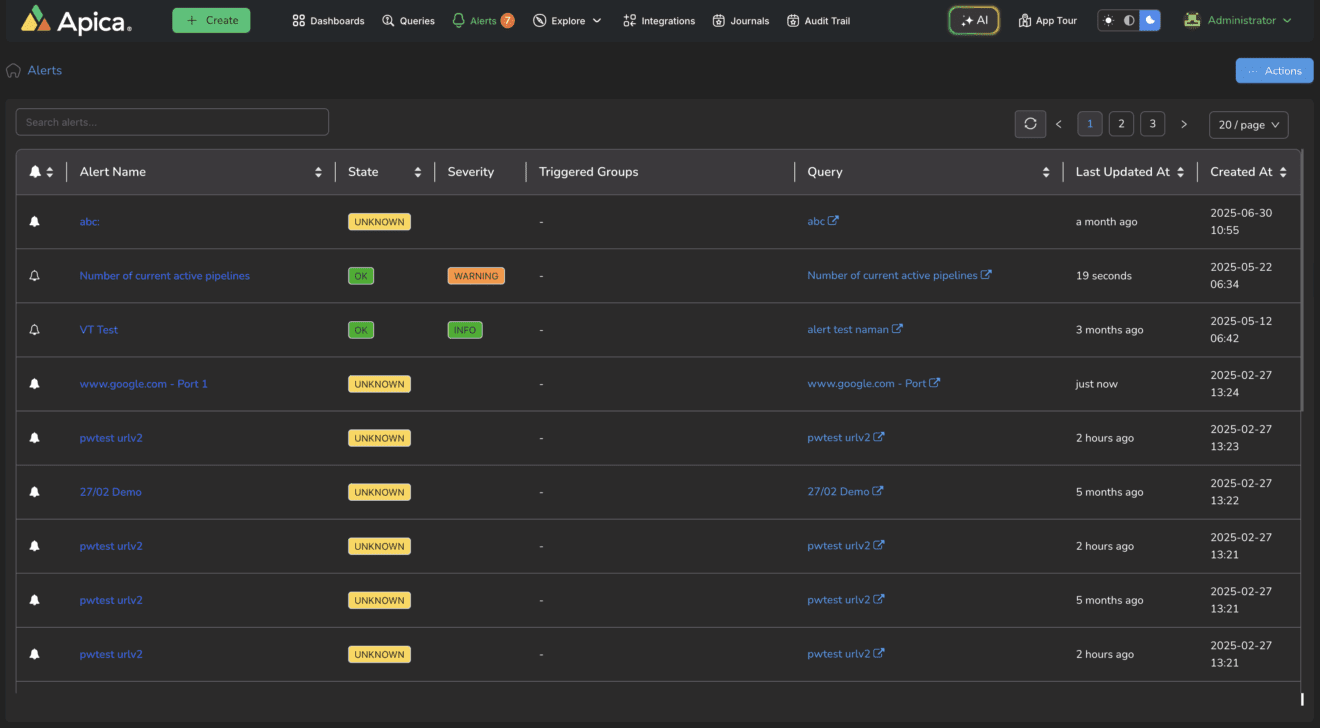
Alert Management
AI-powered alert correlation and noise reduction that ensures only the most critical issues reach your team — faster.
Explore →
Apica Wayfinder
The Test Data Engine for Agentic Journeys
Explore →
Apica Wayfinder Datasheet (PDF)
Download Datasheet →Statistics reflect Apica customer outcomes and publicly available industry research.